Introduction
Water storage is an essential part of every residential and commercial building. Whether it is a small individual house, an apartment complex or a large commercial property, having a reliable water storage system makes everyday water management easier.
Traditionally, RCC sumps have been constructed directly at the site using cement, sand, steel and concrete. While this method is still widely used, modern construction practices are introducing more efficient alternatives.
One such solution is the precast RCC sump.
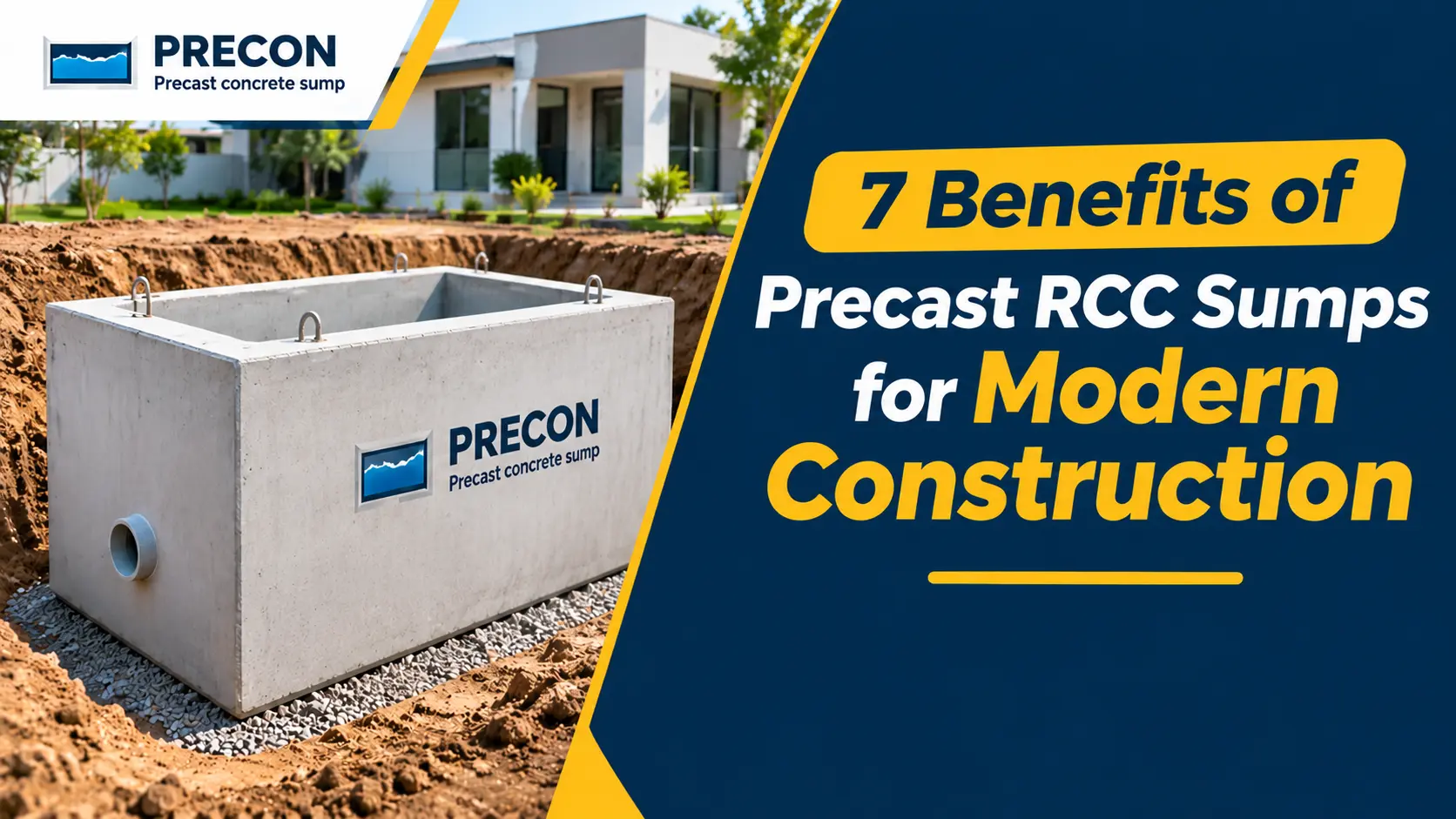
Precast RCC sumps are manufactured in advance using reinforced cement concrete and transported to the construction site for installation. Instead of building the entire sump from scratch, the main structure is already prepared, helping reduce several on-site construction activities.
For homeowners, builders and construction professionals, this approach offers several practical advantages, including faster installation, controlled manufacturing and reduced site work.
But are precast RCC sumps really worth considering?
Let’s explore the seven major benefits of precast RCC sumps and understand why they are becoming a practical choice in modern construction.
What Is a Precast RCC Sump?
A precast RCC sump is a water storage structure manufactured using reinforced cement concrete in a controlled production environment.
The manufacturing process generally involves preparing moulds, placing steel reinforcement, pouring concrete, compacting it and allowing it to cure before transportation.
Once the sump is ready, it is transported to the construction site and installed in a previously prepared location.
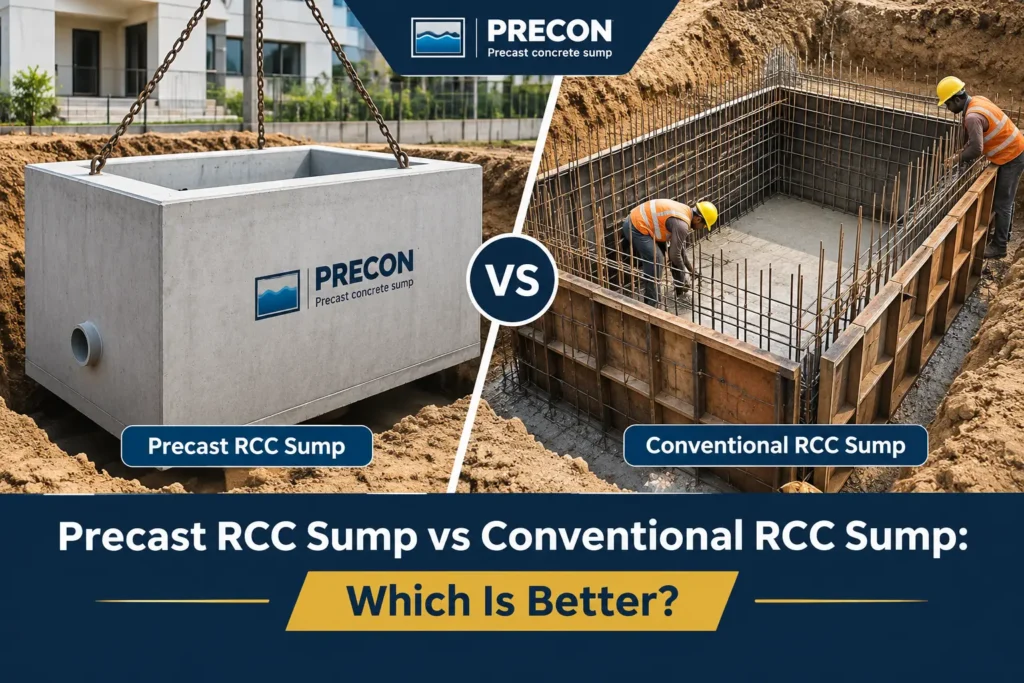
Unlike conventional RCC sumps, which require excavation, reinforcement work, shuttering, concreting and curing at the site, precast RCC sumps are manufactured before installation.
This approach helps reduce the number of construction activities required at the project location.
Precast sumps are available in different capacities and dimensions depending on the manufacturer’s product range and project requirements.
7 Benefits of Precast RCC Sumps for Modern Construction
1. Faster Installation and Time Savings
Time plays an important role in every construction project. Delays in one activity can affect several other stages of construction.
With a conventional RCC sump, the construction process involves multiple steps, including excavation, foundation preparation, steel reinforcement, shuttering, concrete pouring, curing and waterproofing.
Each stage requires time, labour and proper supervision.
Precast RCC sumps help simplify this process because the main concrete structure is manufactured in advance. Once the site is prepared and the sump reaches the location, it can be installed using suitable lifting equipment.
This reduces the amount of construction work required at the site and helps builders manage their project schedules more efficiently.
For homeowners who want to complete their construction within a planned timeline, this can be a useful advantage.
2. Consistent Quality Through Controlled Manufacturing
The quality of an RCC sump depends on several factors, including concrete quality, reinforcement placement, mixing, compaction and curing.
In conventional construction, these activities are performed directly at the site. The final quality may vary depending on material handling, weather conditions and workmanship.
Precast RCC sumps are manufactured in a controlled production environment, where the manufacturing process can be monitored more systematically.
The manufacturer can maintain consistency in:
- Concrete mix proportions.
- Steel reinforcement placement.
- Concrete compaction.
- Curing procedures.
- Dimensional accuracy.
- Quality inspection.
This controlled approach helps improve consistency between manufactured units.
However, quality still depends on the manufacturer’s production standards and proper structural design. Buyers should check the concrete specifications and quality certifications before selecting a product.
3. Reduced On-Site Labour Requirements
Labour availability and coordination are common challenges in construction.
Conventional RCC sump construction requires different activities to be handled by workers at the site. Masons, steel fixers, shuttering carpenters and other workers may be involved in the process.
Managing all these activities requires time and supervision.
With precast RCC sumps, most of the manufacturing work is completed before the product reaches the construction site.
The site team mainly handles excavation, foundation preparation, transportation coordination, lifting and installation.
This can reduce the number of workers required for sump construction and simplify site management.
For projects where labour availability is limited, precast construction can be a practical alternative.
4. Better Control Over Concrete Quality
Concrete quality is one of the most important factors affecting the strength and durability of any RCC structure.
Poor mixing, inadequate compaction, incorrect water-cement ratios and insufficient curing can affect the final performance of concrete.
Since precast RCC sumps are manufactured in a dedicated production setup, the manufacturer can follow standardised procedures for batching, mixing, pouring and curing.
This makes it easier to monitor production quality and maintain consistency.
Proper compaction helps reduce air voids, while controlled curing supports the development of concrete strength.
As a result, a properly manufactured precast RCC sump can offer reliable structural performance.
It is still important to verify that the product meets the required engineering specifications before installation.
5. Reduced Construction Waste and Site Disturbance
Construction activities often generate waste materials such as leftover concrete, broken shuttering materials, packaging and other debris.
When a sump is constructed directly at the site, material storage, mixing and cutting activities can create additional waste and occupy valuable working space.
Precast RCC sumps help reduce many of these activities because the main structure is manufactured separately.
This offers a few practical benefits:
- Less concrete mixing at the construction site.
- Reduced requirement for shuttering materials.
- Fewer leftover construction materials.
- Better organisation of the working area.
- Reduced disturbance to other construction activities.
For residential projects, especially those with limited space, keeping the construction site organised can make a noticeable difference.
6. Long-Term Strength and Durability
A water sump is an underground structure that needs to withstand different types of loads throughout its service life.
Apart from the weight of stored water, it may also experience soil pressure, groundwater pressure and external loads depending on its location.
Precast RCC sumps are designed using reinforced concrete to provide the required structural strength.
When manufactured with good-quality materials, suitable reinforcement and proper curing, they can offer reliable long-term performance.
However, durability is not determined by the concrete structure alone.
Factors such as soil conditions, groundwater level, installation quality, waterproofing, reinforcement protection and maintenance also influence the sump’s service life.
Before installation, it is important to ensure that the product is designed for the actual site conditions.
7. Practical Solution for Modern Residential Construction
Modern residential construction often involves limited plot sizes, planned construction schedules and the need to manage multiple activities simultaneously.
Homeowners want construction solutions that are reliable, convenient and easy to manage.
Precast RCC sumps can support these requirements by reducing on-site construction activities and simplifying the installation process.
They are particularly useful when:
- The project requires faster sump installation.
- Labour availability is limited.
- The site has sufficient access for transportation and lifting.
- A standard sump size meets the required water storage capacity.
- The construction schedule needs better coordination.
For individual houses, villas and selected commercial projects, precast RCC sumps can be a convenient water storage solution when the site conditions are suitable.
Conclusion
Precast RCC sumps offer several practical advantages for modern construction, including faster installation, controlled manufacturing, reduced labour requirements and better site management.
Their durability and performance depend on proper structural design, quality materials, manufacturing standards and professional installation.
For homeowners and builders looking for an alternative to conventional sump construction, precast RCC sumps are worth considering.
Choosing the right construction method today can make your building more efficient, practical and easier to maintain in the long run.