Introduction
A water sump is one of the most important parts of any residential or commercial building. It may not be visible once the house is completed, but it plays a major role in storing water and ensuring a regular water supply for everyday needs.
When planning a new house, one common question homeowners face is whether to choose a precast RCC sump or a conventional RCC sump. Both options are widely used in construction, and both have their own advantages. However, the right choice depends on factors such as construction time, budget, site conditions, available space, durability and maintenance.
Traditionally, most homeowners have preferred conventional RCC sumps because they are constructed directly at the site. But with improvements in construction technology, precast RCC sumps are becoming another practical option.
So, which one is better for your home? Let’s understand how both methods work, their differences, advantages and limitations before making a decision.
What Is a Conventional RCC Sump?
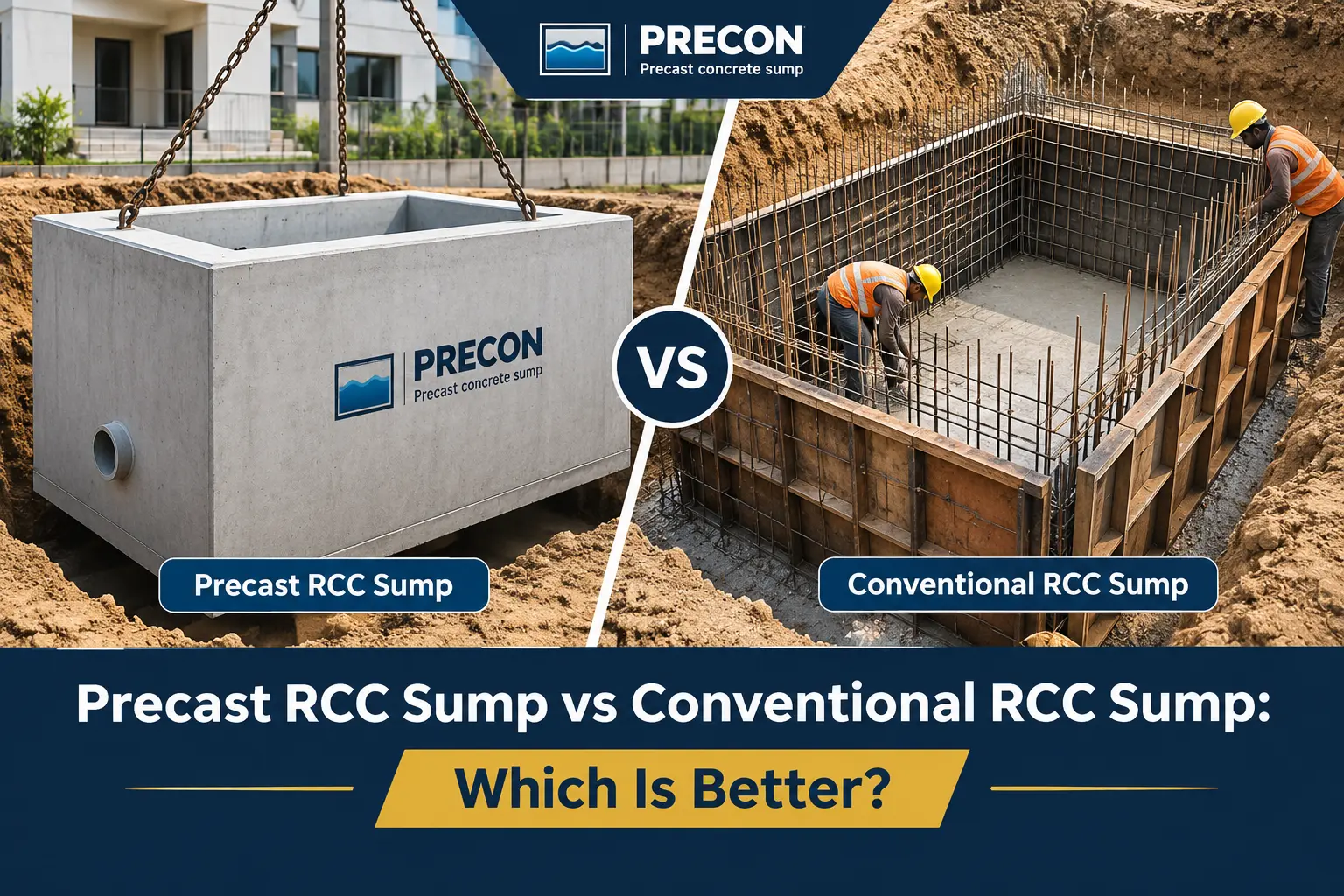
A conventional RCC (Reinforced Cement Concrete) sump is a water storage structure constructed directly at the building site using concrete, steel reinforcement and shuttering materials.
The construction process usually begins with excavation based on the required sump capacity and available space. After preparing the foundation, steel reinforcement is placed, followed by shuttering and concrete work.
The base slab, side walls and top slab are constructed either in stages or according to the structural design. Once the concrete has gained sufficient strength, waterproofing and finishing work are carried out to make the sump suitable for water storage.
One of the biggest advantages of a conventional RCC sump is flexibility. It can be designed according to the available space, required water capacity and specific site conditions.
For example, if a house has an unusual plot layout or limited space, the sump dimensions can be adjusted to suit the available area.
However, conventional construction involves several stages, including excavation, reinforcement work, shuttering, concreting, curing and waterproofing. This makes it a relatively time-consuming process.
What Is a Precast RCC Sump?
A precast RCC sump is a water storage structure manufactured using reinforced concrete in a controlled production environment and transported to the construction site for installation.
Unlike conventional sumps, which are constructed entirely at the site, precast sumps are produced before they reach the project location.
The manufacturing process generally involves preparing the mould, placing steel reinforcement, pouring concrete, compacting it and allowing it to cure under controlled conditions.
Once the unit is ready, it is transported to the site and installed in the prepared location using suitable lifting equipment.
Precast RCC sumps are designed to reduce the amount of construction work required at the site. Since the main concrete structure is already manufactured, installation can be completed much faster than building the entire sump from scratch.
However, transportation access, lifting arrangements, installation requirements and the suitability of the product for the site must be checked before choosing this option.
Precast RCC Sump vs Conventional RCC Sump: Key Differences
Both sump types are designed to store water, but the way they are manufactured, installed and maintained is different.
Let’s compare them based on the factors that matter most to homeowners.
1. Construction Time
Time is an important factor in any construction project.
A conventional RCC sump requires multiple activities at the site. Excavation, reinforcement fixing, shuttering, concrete pouring, curing and waterproofing must be completed before the sump is ready for use.
A precast RCC sump reduces most of these on-site activities because the structure is manufactured in advance. Once the site is prepared and the required lifting arrangements are available, installation can be completed relatively quickly.
Winner: Precast RCC Sump
If completing the construction work within a shorter period is your priority, precast RCC is generally a more convenient option.
2. Construction Cost
Cost is one of the first things homeowners consider when planning a sump.
In conventional RCC construction, expenses include cement, sand, aggregates, steel, labour, shuttering materials, waterproofing and curing. Labour charges and material prices can also affect the overall budget.
Precast RCC sumps may reduce on-site labour and construction activities. However, the total cost includes manufacturing, transportation, crane or lifting charges, unloading and installation.
For smaller projects or sites where transportation is difficult, conventional construction may sometimes be more economical.
Therefore, it is important to compare the complete project cost rather than looking only at the initial product price.
Winner: Depends on the project
The more economical option depends on sump capacity, site accessibility, transportation distance and local labour costs.
3. Quality and Strength
The strength of a sump depends on the quality of concrete, steel reinforcement, structural design and construction practices.
In conventional RCC construction, the quality largely depends on the workmanship at the site. Proper concrete mixing, reinforcement placement, compaction and curing are essential to achieve the required strength.
Precast RCC sumps are manufactured in a controlled environment. This allows better control over concrete mixing, reinforcement placement and production processes.
However, precast does not automatically mean better quality. The manufacturing standards, concrete grade, reinforcement details and quality checks must meet the required specifications.
Winner: Precast RCC Sump, when properly manufactured
Controlled production can help achieve consistent quality, provided the manufacturer follows proper standards.
4. Waterproofing and Leakage
Water leakage is one of the biggest concerns with any underground water sump.
In conventional RCC sumps, leakage can occur due to poor concrete quality, improper curing, cracks, construction joints or inadequate waterproofing.
The base-to-wall joints and wall-to-roof connections need particular attention during construction.
Precast RCC sumps can reduce some on-site construction joints because the structure is manufactured before installation. However, joints, lifting damage, connections and installation details still need proper attention.
Waterproofing and leak testing should never be ignored, regardless of which method you choose.
Winner: Depends on design and workmanship
A properly constructed and waterproofed conventional sump can perform just as well as a good-quality precast sump.
5. Space and Design Flexibility
Every construction site is different. Some homes have enough open space, while others have narrow plots and limited access.
A conventional RCC sump offers greater flexibility in terms of shape, dimensions and capacity. It can be designed according to the available space and site requirements.
Precast RCC sumps are manufactured in predetermined dimensions. This means the available product sizes may limit your choices.
If your plot has unusual dimensions or difficult site conditions, a conventional sump may be easier to accommodate.
Winner: Conventional RCC Sump
For customised dimensions and irregular spaces, conventional construction offers more flexibility.
6. Labour and Site Management
Conventional sump construction involves several activities and requires coordination between masons, steel workers, carpenters and other workers.
It also requires regular supervision to ensure that the reinforcement, concrete work and waterproofing are completed correctly.
Precast RCC sumps reduce the amount of work required at the site. Since the main structure is already manufactured, fewer construction activities are involved during installation.
However, skilled workers and suitable equipment are still required for unloading, positioning and installation.
Winner: Precast RCC Sump
It can reduce on-site labour requirements and simplify construction management.
7. Durability and Maintenance
Homeowners generally expect a water sump to last for many years without frequent repairs.
Both precast and conventional RCC sumps can offer long-term durability when designed and constructed properly.
The lifespan depends on several factors, including concrete quality, reinforcement protection, soil conditions, groundwater levels, waterproofing and regular maintenance.
Poor construction practices can lead to cracks, leakage and deterioration in either type of sump.
Regular inspection and proper cleaning are important to maintain water quality and prevent long-term issues.
Winner: Both
Durability depends more on material quality, engineering and maintenance than simply choosing precast or conventional construction.
Advantages of Precast RCC Sump
Precast RCC sumps are becoming a practical choice for homeowners looking for faster construction and reduced site activities.
Here are some of their major advantages:
- Faster installation: Since the main structure is manufactured in advance, on-site construction time can be reduced.
- Controlled manufacturing: Production in a controlled environment helps maintain consistency in concrete quality and reinforcement placement.
- Reduced labour: Fewer on-site construction activities can reduce labour requirements.
- Less site disturbance: There is generally less shuttering, concrete mixing and construction-related activity at the installation location.
- Predictable production: Manufacturing can be planned in advance, making project scheduling easier.
However, proper transportation, lifting, foundation preparation and installation are essential to achieve the expected performance.
Advantages of Conventional RCC Sump
Even with the availability of precast solutions, conventional RCC sumps remain a popular choice in residential construction.
Some important advantages include:
- Customised design: Dimensions, depth and capacity can be adjusted according to the site.
- Suitable for restricted access: Construction can be carried out even when large vehicles or lifting equipment cannot reach the location.
- Flexible construction: The sump can be designed around existing structures, underground utilities and site limitations.
- Local material availability: Cement, steel and aggregates are generally available through local suppliers.
- Familiar construction method: Most construction teams have experience with conventional RCC work.
For projects requiring specific dimensions or customised layouts, conventional RCC construction can be a suitable solution.
Which Sump Is Better for Your Home?
There is no single answer that works for every construction project.
If you are looking for faster installation, reduced on-site labour and controlled manufacturing, a precast RCC sump is worth considering.
On the other hand, if your site requires customised dimensions, has limited access for transportation or involves unusual ground conditions, a conventional RCC sump may be a better choice.
Before making a decision, consider the following factors:
- Water storage capacity: Calculate your household’s daily water requirements and decide the required sump capacity.
- Available space: Check the dimensions and depth available for sump installation.
- Site accessibility: Make sure transportation vehicles and lifting equipment can reach the installation location if you choose precast.
- Soil and groundwater conditions: Underground water pressure and soil conditions should be considered during structural design.
- Total project cost: Compare material, labour, transportation, installation and waterproofing expenses.
- Quality assurance: Check concrete specifications, reinforcement details, structural design and waterproofing arrangements.
It is always better to discuss these factors with an experienced construction professional before finalising the sump type.
Common Mistakes to Avoid While Choosing an RCC Sump
Choosing a sump based only on price or construction speed can create problems later.
Here are a few common mistakes homeowners should avoid.
1. Choosing the wrong capacity
A sump that is too small may not provide sufficient water storage for the family. At the same time, an unnecessarily large sump can increase construction costs and occupy valuable space.
2. Ignoring waterproofing
Even a strong RCC structure can develop leakage if waterproofing and joint treatment are not handled properly.
3. Not checking site accessibility
Precast sumps require transportation and lifting arrangements. Failing to check access before ordering can lead to installation difficulties and additional expenses.
4. Ignoring structural requirements
Underground sumps must be designed to withstand soil pressure, groundwater conditions and other relevant loads. A proper structural design is essential.
5. Focusing only on the initial cost
A cheaper option may not always be the most economical in the long run. Consider installation, maintenance, durability and repair costs before making your decision.
Conclusion
Both precast RCC sumps and conventional RCC sumps have their own advantages.
Precast RCC sumps offer convenience, faster installation and controlled manufacturing. Conventional RCC sumps provide greater design flexibility and can be constructed according to specific site requirements.
The best choice is the one that suits your plot, water storage needs, construction budget and project timeline.
Remember, a water sump is not something you want to repair frequently after completing your house. So, focus on proper design, quality materials, professional installation and effective waterproofing rather than choosing an option based on price alone.
A well-planned sump will support your home’s water requirements for years to come.